

REVIEW: How to Make a Mess at Upstairs at the Gatehouse until 28 June 2026
'the joys of cooking' ★★★★
Previously called Becoming Nigella, the musical by Emily Rose Simons, had a title change to the more apt How to Make a Mess. Hearing the byline, I imagined something like the semi-biographical film, Nora Ephron’s Julie & Julia, in which Amy Adams and Meryl Streep play characters whose lives become entwined when Julie starts a blog about cooking each of Julia Child’s recipes from Childs' first book about French cooking over a year. (An interesting foodie aside: Stanley Tucci, who plays Childs’ husband, can be found with his own recipes in the cookbook section lately.) Rather, this story takes us to the aching heart of Anna (Natasha Karp), who lost her father to another family when she was young and is now about to lose her until-recently-estranged mother. On the evening of her birthday, she opens Nigella Lawson’s seminal book, How to Eat, a past gift from her father, and, much like rubbing a genie’s bottle, the domestic goddess (Tanya Truman) herself appears (this is more than an apparition caused by the edibles Anna took). In some ways a formulaic recipe to conjure up, and yet somehow, it works; and Nigella is embedded into Anna’s kitchen and life. Anna is quite the opposite of Nigella. She doesn’t cook, doesn’t want to cook, and even orders her morning coffee to be delivered. Thus, a new chapter begins.
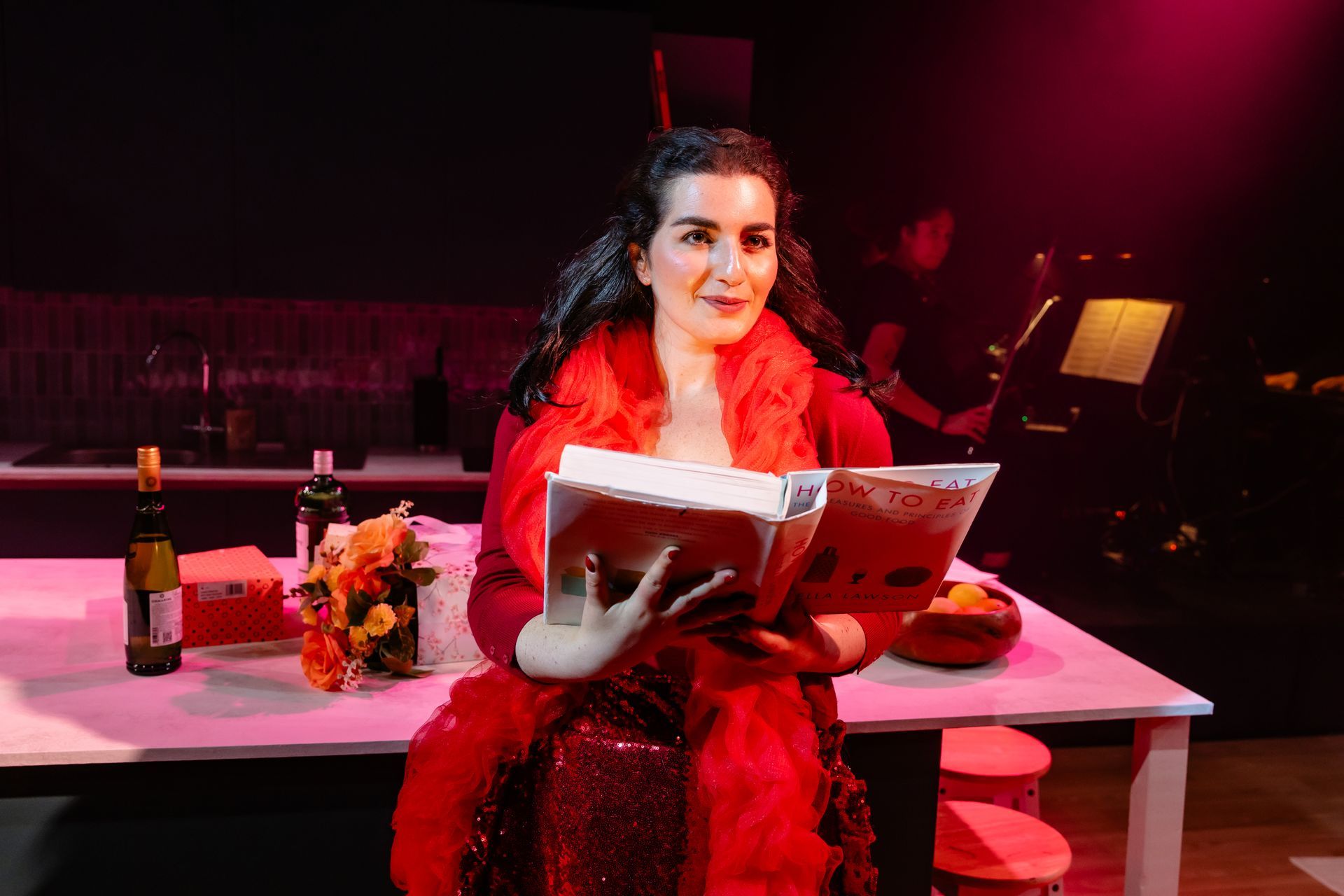
Nigella arrives with steamy looks at the audience (expected), slightly salacious comments, and starts off with a red feather boa over a red sequined apron atop her tight-fitting red dress. Truman musters the famously sensual version of the famous TV chef. However, she evolves into more counselor than cook to Anna, who lives an active social life where nobody really knows her. Anna doesn’t even let her workplace know her mother is dying. Our diva becomes her confidante and support system. There is melancholy in this piece, but it is not overly sentimental, such as with the song “How Will I Say Goodbye?”. The real energy, however, erupts when the cooking begins - the making of a mayonnaise, splitting eggs and dropping oil “from an elegant height” - but that happens only halfway through the show.
The instrumental trio, positioned next to the kitchen, was on point with keyboards, cello, and reeds (flute, alto sax, and clarinet) pushing the musical narrative forward perfectly. The music is uplifting and at times meditative; the most memorable pieces are the duets, with high energy and musical punctuation. When the pair sings “Nothing Like My Mother”, they belt out their piece facing each other directly and it is riveting. I wanted to know more about Nigella’s relationship with her mother after the song, but the lyrics only indicate early labour as a child, referring to “tiny feet on adult chairs”. Perhaps, much like a real life counselor, this Nigella is not talking (or rather, singing) too much about herself.
The set has a kitchen I would like to cook in (meticulously designed by Christianna Mason), with its teal and white decor, central island, and clean lines. If house porn is more your thing than food porn, this may be reason alone to see the show. One thing that strangely feels at odds with the realistic set is at the pinnacle of Nigella’s wooing of Anna to the gourmande side: several types of large models of hanging cheese drop down from the grid. It may serve to remind us that this Nigella may or may not be a spirit or a djinn, but it felt a bit jarring to see large pieces of papier-maché cheese making an appearance, even if it was for a lesson in how to taste.
The dialogue has moments of humour between the diametrically opposed characters. At one point Nigella asks Anna what mental condition she has. Is it grief? “No, you.” comes the reply. The ever-confident Nigella retorts, “We should all have such a condition.” Nigella might be the genie, but as with all who grant wishes, she eventually disappears, and Anna has to face her real ghosts - building her relationship with her father.
There is much connection between food and family in this piece. As in Julie & Julia, there is a key dish that has to be mastered and roast chicken is the one for Anna, not because of complexity, but because of familial memory. As someone who was very late to cooking myself (yes, there are others like Anna), many of Nigella’s words of wisdom to Anna, oft quoted from the book, spoke to me: “Although it's possible to love eating without being able to cook, I don't believe you can ever really cook unless you love eating.” Such quips served to remind the audience of the joys of cooking and how sensual an experience it is, as only Nigella can. The lyrics in this piece have a way of speaking to the heart as much as the dialogue, even if the tunes disappear from memory. Even as the characters make a mess in the kitchen, Anna learns to accept the mess in her heart. And the viewer needs to accept that this production is more of a simmer than a boil.
HOW TO MAKE A MESS at Upstairs at the Gatehouse 16 - 28 June 2026
Written by Emily Rose Simons
Performed by Natasha Karp,Tanya Truman
Music performed by David Merriman, Josie Campbell, Ruth Whybrow
Directed by Grace Taylor
Musical Direction and Arrangements by David Merriman
Set and Costume Designer: Christianna Mason
Lighting Designer: Chris McDonnell
Sound Designer: Richard Carter
Produced by Tanya Truman Productions
Photography: Danny Kaan