







INTERVIEW: Playwright TIM GRAVES on his play WALKING EACH OTHER HOME at OLD RED LION THEATRE
28 April – 16 May 2026
Tim Graves is a gay author and playwright who lives in London. He is also the founder and Artistic Producer of Seraphim Theatre Company which produces LGBTQ+ theatre. 'Walking Each Other Home' is his latest play which explores the father-son relationship dynamic, Amazonian shamanism, and the Sikh faith from a queer perspective.

LPT: Hello Tim, delighted to have the opportunity to ask you about this rather unusual play. Where did the inspiration arise?
Tim Graves: From a fraught conversation with my father. I was living in Ecuador from 2020 until 2024 and flew out to visit my dad in his house in the Suffolk countryside during the heatwave of 2022. He was, by now, suffering from early-stage dementia and had forgotten that I was gay. When I reminded him, he put his head in his hands and told me not to tell the neighbours. It was like coming out all over again forty years later; I found the conversation both emotionally triggering but also funny. Then and there, I knew it would be the inspiration for a play. I travelled back to Quito, Ecuador and began writing the first draft.
Your characters have huge differences in culture, age and lifestyle. Could you let us know a little about each of them.
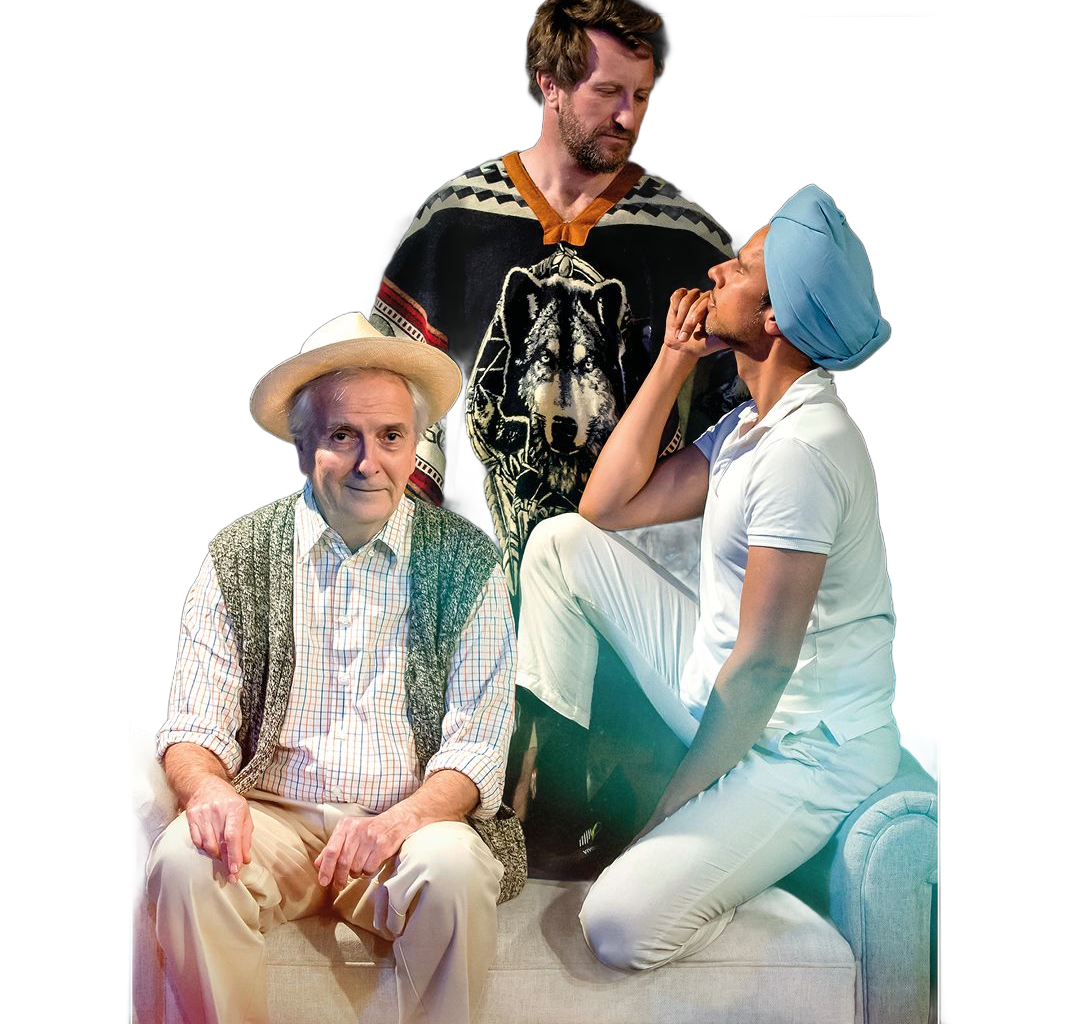
Frank Maloney is the father who lives in a dilapidated cottage in the Norfolk countryside and suffers from early-stage Alzheimer’s. He is homophobic and is suffering from prolonged grief for his other son.
Michael Maloney is a gay, middle-aged digital nomad who has been living in Peru for the last few years. He is passionate about Amazonian shamanism but experienced a traumatic childhood and has a difficult relationship with his father, Frank
Sandeep Singh is a young gay man of Punjabi Sikh heritage. He cares for Frank and also had a troubled relationship with his own father.
Image below: The cast left to right, Edward Fisher as Michael, Amrik Tumber as Sandeep Singh, Christopher Poke as Frank

The stage is set for an emotional roller-coaster but the scenario suggests that we might expect quite a lot of humour along with the discord. Is it a fine line to tread?
‘Walking Each Other Home’ is billed as a tragi-comedy. I can’t give too much away regarding the tragic elements in the storytelling. But much of the humour (and pathos) in the play comes from the incongruity between the three different worlds the characters inhabit. Dramatic irony, word play and even an element of slapstick is also used to comic effect. However, I think the comedy and tragedy is interwoven in such a way that they work to enhance each other.
You have three wonderful actors, Amrik Tumber (as Sandeep), Edward Fisher (as Michael) and Christopher Poke (as Frank). How do they match up to the characters you had in mind when writing the play?
Amrik is of Punjabi Sikh heritage and so is Sandeep. He is also a very talented actor and perfect for the role, bringing qualities to Sandeep that enhance and add what I originally had in mind. Amrik has also been incredibly helpful to me as the playwright when I needed some advice about either Sikhism or Punjabi.
We held a recasting audition for the character of Michael in February and are delighted to have Edward Fisher onboard. He brings a real warmth and empathy to the character of Michael and fully understands the spiritual dimension of the play.
Award-winning actor Christopher Poke at times uncannily reminds me of my own father who Frank is loosely based. So just as I had imagined!
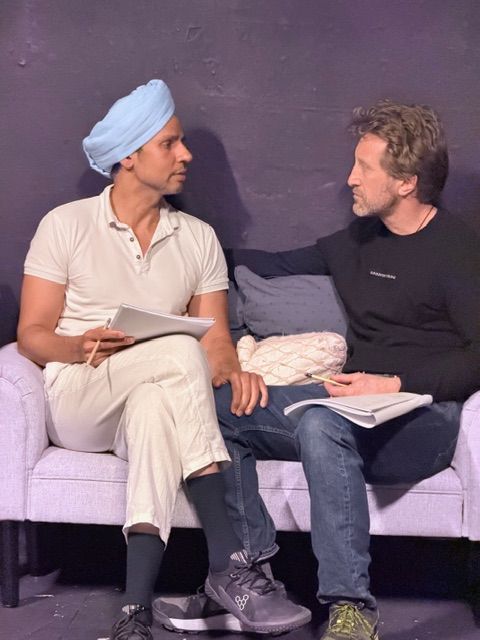
Images below: The cast in rehearsal

It makes a change to have a play which can be described as deeply spiritual. How far does this reflect your own philosophy of life?
‘Walking Each Other Home’ reflects both my philosophy and experience of life. I have explored Western Buddhism and mystical /gnostic Christianity and also taken part in many plant medicine ceremonies in South America. I have also studied Andean shamanism, Core shamanism and have trained in reiki and TCM acupuncture. I borrowed the title ‘Walking Each Other Home’ from the gay spiritual guru and beautiful human being, Ram Dass, who has now passed. I love the idea that we are all just walking each other home – that our interactions and relationships with each other, teach us, even the difficult ones, how to become wiser and more compassionate – more fully human.
Your first play 'Among Angels', which focussed on the chemsex epidemic within the LGBTQ+ community, was staged at The Courtyard Theatre in Hoxton. Is there a strong reason for bringing your second play to Old Red Lion pub Theatre in Islington?
I love the intimacy of the space at The Old Red Lion. The stage and seating capacity is smaller than The Courtyard but this works in our favour; it is ideal for an emotionally intense three-hander. Jack, the Artistic Director, is also very encouraging and supportive of New Writing. The theatre is also in a great location.
Queer stories have become quite mainstream but it’s been a struggle to achieve this kind of acceptance. Do you believe there is still a long way to go?
Queer stories, in all their glorious range and diversity, are indeed being told on stage, film and T.V and should continue to be told; they reflect an essential part of the human lived experience. Politically, with the situation in the U.S and the rise of Reform and the far right in the UK, the LGBTQ+ community has a fight on its hands. As Russel T. Davis has said, ‘If you’re queer in 2026, you’re a political act.’ In the current climate, there is even more of a need to tell queer stories.
You have also published two novels with Paradise Press - 'Homo Jihad' which was shortlisted for the Polari First Book Prize in 2010, and 'Pharmakeia.' Could you tell us what is different in your writing process for the stage?
Novelists and playwrights both tell stories so I think a good playwright also has to be a good storyteller. That is a given. However, when I’m writing for the stage there are different elements to focus on: dramatic structure, dramatic tension, pace; this is all revealed through the dialogue of course. There is more of a sense of urgency and immediacy. And the rehearsed reading, which we held in November last year at The Old Red Lion, is also a unique part of the process when writing for the stage.
Is there a particular scene in Walking Each Other Home that was especially difficult or easy to write?
Yes! The penultimate scene of the play was challenging to write and took a lot of editing and redrafting. Michael, the middle-aged gay son, recounts a profound ayahuasca experience to Sandeep which is encapsulated in a vision of two very different timelines for humanity. It was the content of the vision Michael shares, Sandeep’s response to this and moving the dialogue into a more elevated poetic form, plus the pressure of writing an ending which, let’s be honest, can either make or break a play - this was difficult to write but worth the struggle as, for me, it’s one of the most beautiful scenes in the play. But one which comes with a message of real urgency for humanity.
We’d also be interested to hear about your favourite scene.
A tricky one! I like so many of the scenes but for different reasons and I can’t give too much away. However, there is a scene in Act 2 between Michael and Sandeep which is vital to Michael’s character arc, spiritual, emotionally charged and profoundly healing for Michael.
Who is going to be boss in the rehearsal room. Will it be you the writer or the director, Jason Marc-Williams?
We are already well into rehearsals now. As the playwright, I am in every rehearsal to authorise any minor changes to the script. As the producer, I am there on the production side of things. However, the action and shape of the play is very much Jason’s vision. I am in awe of how Jason works with the actors; he is an incredible theatre director, and I feel very blessed to have him onboard to direct this piece.
Finally, what are you most looking forward to sharing with audiences?
A play which invites the audience to see the unfolding drama through three different lenses – Frank’s Alzheimers. Michael’s passion for Amazonian shamanism, and Sandeep’s Sikh faith. Ultimately though, this is a play about love and the different guises it can take. Above all, I’m looking forward to sharing that.
WALKING EACH OTHER HOME is at OLD RED LION THEATRE in Islington 28 April - 16 May 2026
Due to a family crisis, Michael, a gay middle-aged digital nomad, returns home from Peru to visit his homophobic father, Frank. Only Frank is now suffering from early-stage dementia and being cared for by Sandeep – a young, mysterious gay Sikh man. As for Michael – he’s struggling to process unresolved childhood trauma after an overwhelmingly intense ayahuasca ceremony in the Amazon jungle. The stage is set for an emotional roller coaster of a ride…
The audience is invited to view this deeply spiritual and beautiful piece of work through three unique lenses: Frank’s Alzheimer’s. Michael’s love of Amazonian shamanism. And Sandeep’s Sikh faith.
A Seraphim Theatre Company Production