
LPTM: Hello Tania, delighted to have this opportunity to discover more about your play and your newly emerging theatre collective LIGHT THE NIGHT. Firstly, please could you give us an overview of the play; the story and the characters.
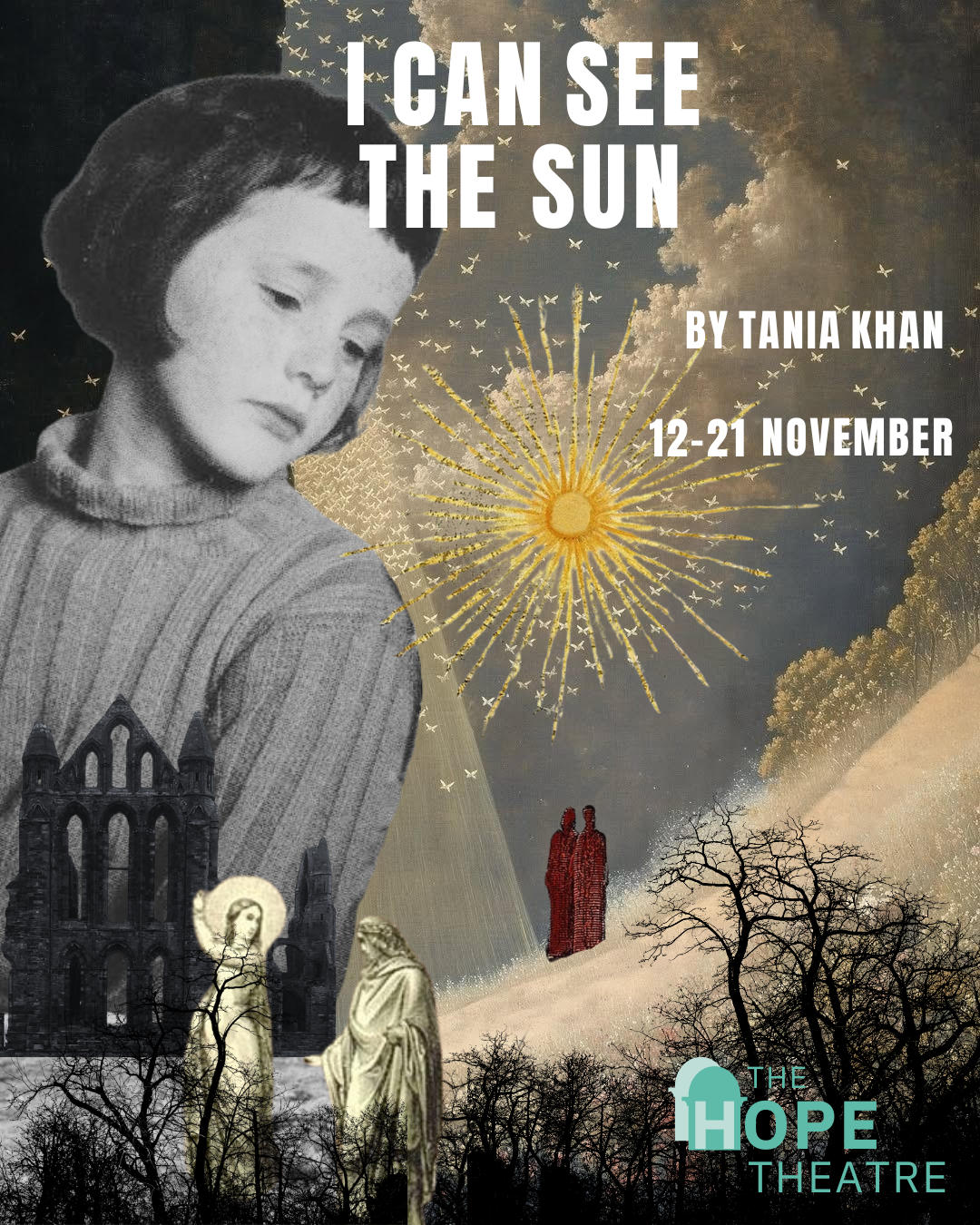
Tania Khan: I Can See The Sun is a bizarre, darkly humorous drama inspired by Dante’s epic poem The Divine Comedy.
After taking a wrong turn at Goole on the road back from IKEA, a mother and daughter become lost in the ‘Dark Wood’ on the North York Moors, where they encounter a strange hiker in the dead of night. In this ancient landscape, they’re guided to confront buried fears and ancestral inheritance.
We are most interested to see that the company aims to platform socially and environmentally themed, multidisciplinary plays. How does I CAN SEE THE SUN hit the social and environmental brief?
Our aim is to explore environmental and social themes through story-driven theatre that uplifts and inspires. Though facts and figures are vital, we want to get to the heart of humanity’s relationship with the environment and other species.
While our previous plays have more explicitly foregrounded environmental themes, I Can See The Sun subtly explores how we interact with the natural world, and how this interaction shapes our closest relationships. At its centre, it’s a human story of hope and redemption.
We notice that you also have a background in contemporary dance, choreography and fine art. How far do these feed into the multidisciplinary aspect of the play?
The company’s work is often image-led, collaging live music, video projection and movement. I trained in acting, contemporary dance, fine art and creative writing, and draw on this multidisciplinary background to incorporate choreography and visual storytelling into the text. I love blending genres—from Gothic Horror to Kitchen Sink.
Could you tell us more about your experience of theatre that has brought you to this point in your career.
I’ve been performing all my life, and came to playwriting a little later. My first play was a one-person spoken-word story about East London, which was accepted onto the Royal Court’s Young Writers Programme. The following year, I went on to study acting at RADA. After graduating, I became involved in environmental advocacy, which inspired me to form a company that could address some of these themes through multidisciplinary theatre.
When did the inspiration for the play first come to you?
I Can See The Sun began as a short poetry play in response to another show, exploring English culture and the ways we express emotion. It was set in Yorkshire, which resonated with part of my own family history.
You’re playing the role of Grace. How much of yourself have you written into the role?
I think there are often elements of yourself in the characters you perform or write, particularly when drawing on lived experience. Grace is no exception, though she’s also very much a fictional creation.
The synopsis of the play gives a very surreal and other worldly impression. How are you able to support this visually?
Blending naturalism with heightened theatricality and video projection, the visual world of the play is both tangible and otherworldly, transforming the space into somewhere on the edge of realism. I’m interested in creating a world that feels physically recognisable while also being symbolic.
It also promises to be darkly humorous. Please tell us more about this and how much of it is in the writing, the director or the acting.
The play collages surreal humour with psychological realism, moments of farce and poetic language. There’s something inherently absurd about the characters' approach to the situation they find themselves in.
coming from British / South Asian heritage, does the play bring a cross-cultural experience? Please tell us more about that.
I feel that coming from geographically mixed heritage and being exposed to many cultures is a privilege that can allow for an objective view of societal norms. In part, the play explores modes of behaviour that have shaped England over the last few centuries, and asks how they influence our society and relationships today, while drawing on the ancient wisdom and folklore that surround the awe-inspiring landscape of the North York Moors, where the play is set.
We also notice that the Following a year of development with support from ArcolaLAB. How did that help to ferment the development of the play?
We began developing the play last December, through the generosity of ArcolaLAB, a programme supporting the development of new work by refugee and ethnically diverse artists. Arcola gave us the opportunity to do a five-day R&D, followed by a WIP showcase. Since then, the play has evolved through two more R&Ds and a research trip to Whitby and the North York Moors!
Finally, who would you most like to see in the audience (and why)?
We’d love our audiences to include local people and those who are new to live performance, alongside regular theatre enthusiasts. We want to reach people who don't usually go to the theatre, and hope they’ll also be inspired by the power of drama.
Light the Night Theatre present
I CAN SEE THE SUN
THE HOPE THEATRE, Islington 12 – 21 November 7pm
"...real visual beauty... a richness of ideas, a daring vision...
excellent directorial and visual dimensions."
— Everything Theatre
Box Office: 0333 666 3366
A surreal, darkly humorous drama inspired by Dante's Divine Comedy. After taking a wrong turn at Goole on the road back from IKEA, a mother and daughter become lost in the 'Dark Wood' on the North York Moors, when they stumble on a stranger in the dead of night. Is he a hunter out to steal hearts, or a moorland hiker who's seen the light? Will they row across the river into deeper despair, or find the path to the car before sunrise?
CREATIVE TEAM
Writer/director: Tania Khan
Associate director: Hope Wishart
Design Consultant: Alice Edgar
Videographer: Jessica Brauner
Stage Manager: Catalina Diaconescu
Lighting designer: Cian Feasey
CAST
Lucy: Karen Cass
Noah: Ethan Dillon
Grace: Tania Khan